Thursday, 28 November 2013

November Newsletter 2013
Change  - PART 1
Do you want to change? 

When I was 30, I craved change.  Every part of my being was yearning for something else.  One afternoon, as a friend and I sat with our young kids playing at our feet, I delivered a meandering manifesto about wanting to do other things.  “But what? What other things do you want to do?”, she asked so logically and pointedly.

The truth is I did not know.  And I was afraid I may never have the answers.  All I felt was a yearning, a stuckedness and a need for things to be different.

Social scientists, business analysts and psychologists have studied human change in its many forms.  Controlling change is the key to improving behaviour and outcomes.


Here is a well known depiction of change:

This follows the stages a person may go through as they move from first noticing that a change for the better is required, to taking action, trying to sustain new habits and dealing with a likely return to old patterns.  What I like the most about it is the upward spiral in the middle.  I’m guessing that as you are reading this, you are probably past pre-contemplation and at least at the point of thinking things could be different.

What is not shown here is that there may be painful emotions and cognitive blocks that stop us from changing and keep us stuck, no matter how enthusiastic and ready for change we may be.  Mark Pearson  (Pearson, M., & Wilson, H. (2009). Using expressive arts to work with mind, body and emotions. Theory and practice. London: Jessica Kingsley Publishers.) writes about how expressing and releasing emotions in a safe and supported environment allows clearer thinking to occur and new self-awareness and knowledge to develop. Repressing and not acknowledging the emotions that are holding us back may mean we continue to stay stuck.  In fact, change may actually feel more like this:

That’s me and my heart in the boat, facing the waves of change.

Michael Rennie, the Managing Partner of McKinsey and Company ( NZ and Australia ) and cancer survivor gave a fantastic talk on change at the Creative Innovation Conference in 2010.  For me, Michael’s main points can be summarised thus:
  • Humans resist change.  There is risk in doing things differently, a risk of being judged as different or crazy.  Humans have evolved to to seek and create stability and control.
  • All innovation threatens what is in place. The status quo offers safety.
  • We need drive to take the risk to push through this resistance to change.
  • Meaning and Purpose fuels our drive – it is important to regularly connect with our meaning and purpose in order to persistently follow our new direction.

I especially like his focus on connecting to your meaning and purpose when you need the strength to persist and grow in spite of resistance.  There are many creative ways that we can discover and connect to our meaning and purpose, and I will outline more of these in newsletter to come.

If you feel the need for change, gather your resources and gather your strength, and remember these key things.

  • Change is fundamental to life.  It’s happening all around you and by choosing to harness it you will be empowered rather simply reacting to your environment.
  • Change can be incremental - it’s important to both be patient at times and to take time to acknowledge and celebrate when change has occured.  Even tiny persistent changes can lead to wonderful transformations.
  • Change requires commitment.  There is no way around this one, you need to be brave and upfront about what you want to do.
  • Change requires action.  These can be tiny steps, but the only way to crack through inertia is by consistent acts of defiance.
  • Change is ongoing and never ending.  This is great news because we don’t need to be disheartened if we don’t wake up to a miracle.  Instead we can be assured that we are participating in an ongoing upward cycle of learning and growing.
  • Change is supported by your own brain biology - neuroplasticity is real and it is your friend.
  • Positive change requires self awareness and self knowledge - creative and expressive tools are wonderful ways to gain these.
  • Last of all, change requires resources and you don’t have to do it alone!

Twelve years on, I am here to tell you that change did happen!  It was not what I expected, but it is so much more.  And now I am offering you my services as a counsellor, specialising in creativity and self expression to help you make the change you want in your life.

In the coming newsletters I will be exploring the ways that creativity, emotional release and support, mindfulness and action can help you to harness change and live your life more fully.  

But first try this Michael Rennie inspired exercise.

Ask yourself “What will change if I put my creative thought into action – what status quo will change?  Do I want to change?”

Choose a safe, quiet, supported space. Take a few moments to breathe deeply and listen to the small voice within. Break out the coloured pencils if you like, draw a picture or put on some gentle music and write down or voice record your thoughts.  Contemplate the question and explore what change will really be like for you.  Make sure you allow yourself plenty of time to reintegrate back in to the day after your contemplation.

I would love to hear if you tried this out or what stage of change you feel may be at.  Feel free to comment below or email me if you have further questions.

Happy little changes, 

Kind regards, 

Fiona Claire.

Work with me: Individual Counselling, Creativity and Therapeutic Singing and Songwriting Sessions by appointment. Email: fionaclaire@optusnet.com.au or call 0437 985 132

Friday, 18 October 2013


October Newsletter 2013
Waiting?

A few days ago, whilst I watered the pot plants in the back yard, I noticed a self-sown lettuce that had been growing quietly during the winter months, and was now looking full and ready to eat.  “I’ll pick that soon and pop it in a bag in the fridge so it stays fresh and use it in a salad”, I thought to myself, imagining grabbing it firmly at the base and twisting off the whole head of lettuce at once.

Today, as I hung out the washing in a swift, warm breeze, I saw that the lettuce was now past it’s best days, and it’s large juicy leaves had wilted, leaving a bitter stalk.  I had waited too long.

I felt a quick rise of frustration and an old “tape” started in my head.  “Why didn’t I take action and pick it? What stopped me? I hesitated and lost - again!”.  I felt a familiar wave of guilt that I had let the plant go to waste.  And then I had to have a wry laugh at myself.  It has been a regular pattern since I was a little girl to wait.  I was in the habit of saving my chocolate Easter eggs so long, they became white and unappealing by the time I unwrapped their colourful foil.  I have kept special hand cream until it became congealed and sour.  Saved fancy cheeses, waiting for the right dinner party, only to find the use-by date long passed.  Waiting for the right time to indulge.  Waiting too long.

Sometimes I have saved something for the right moment and it has been worth the wait.  Saving the last chapter of a good book until I have a quiet time to savour it.  Saving some chocolate until the night that I “need” a chocolate fix and will appreciate it.  But when I really think about it, more often than not, my saving and waiting has meant that I haven’t got the best use out of something, I have saved it so long it is out of date, out of fashion or the excitement has just gone.

As we grow older and sometimes wiser, we do well to take the time to observe which habits serve us well and which would be better off challenged.  Our most tenacious habits can be at work in so many parts of lives and go undetected unless we open ourselves up honestly to other ways of doing things and question the patterns that repeat on us.  First becoming aware, then deciding to change, connecting to the benefits that will come to us, trying out some alternative behaviours and so the process goes.  Changing slowly and compassionately, giving ourselves a pat on the back when we try something new, being kind to ourselves when we repeat old patterns.  Starting again.


As I went for a luxuriously long, sunny walk with my little dog today, I noticed some beautiful gardens and homes and also noticed my reaction to them.  Sometimes a stab of yearning or jealousy and a hope that I will have such a garden of my own one day. “When I get there - to the time in the future, when everything is in place, lined up, when the time is right.”  Suddenly I felt something new, something that is growing stronger and stronger as the years go by and I reap the benefits of taking action in my life - real action connected with my deeply personal vision and goals - I felt “This time is now!  What am I waiting for?  I am lucky to have a home of my own, a place to nurture and polish, a life that I have nourished and developed.  I want to claim my happiness and satisfaction - now”.
I have no need to wait.  I am claiming my prize now.
There are many things that I am happy to say I don’t wait for.

I don’t wait:
  • to tell my children that I love them.

  • before I cuddle my dog.

  • to smell a rose that looks inviting.

  • to sing a song when one comes to mind.


I am lucky that I have had many wonderful mentors and teachers to encourage me to explore my inner world and the things I would change, and to give me the tools to begin to change them.

If there are things you would like to do, or to change, don’t wait. What would you be waiting for?  The perfect time?  Do them now - this is the only time we have.

What would you like to do?


P.S.  I got the idea for this newsletter today - and here it is,  I didn’t wait to write it!

Kind regards, 

Fiona Claire.

Work with me: Individual Counselling, Creativity and Therapeutic Singing and Songwriting Sessions by appointment. Email: fionaclaire@optusnet.com.au or call 0437 985 132


Monday, 23 September 2013


September Newsletter 2013
walking....

It is nearly midnight, so perhaps I am not setting a good example of avoiding procrastination.  But the kids are asleep, the animals are all ensconced at the pet-sitters, my partner is in bed readying himself for the long drive ahead, and a batch of muffins are in the oven - they will be snacks for our family road trip to Adelaide tomorrow.  So perhaps this is just the first time I have had to sit down and write this month’s newsletter.  And it feels good to be writing now, when the house is quiet and the other jobs are done.


Sometimes we expect everything to get done by a certain deadline, and, try as we might, the tasks just won’t hurry up, they insist on being done in their own time.  I have many dreams like this; literally pushing things up hills, coaxing vehicles to go faster, all manner of different metaphors for frustration.  I have very few dreams of simply promenading in the park, or letting things run their own course.  Perhaps my sub-conscious doesn’t see these activities as newsworthy.

It reminds me of the fixation our society seems to have with extreme exercise and pushing the limits as being the only signs of worthy effort, when science and history will show us that it is gentle consistency that often yields the best results.  The patient inventor making yet another tiny adjustment, the many hours of careful planning for the mountain climber, the silent tracker following a potential meal without stepping on a twig - the careful meditative walk rather than the adrenaline fuelled sprint.

“Humans”, writes Gretchen Reynolds, “are born to stroll”.  Ms Reynolds was interviewed by Tara Parker-Pope for The New York Times, Health and Science section about her recent book on health and fitness. ( see http://well.blogs.nytimes.com/2012/05/04/the-surprising-shortcut-to-better-health/  ).  In her interview she said “One of the biggest misconceptions is that exercise has to be hard, that exercise means marathon running or riding your bike for three hours or doing something really strenuous. That’s untrue and, I think, discourages a lot of people from exercising. If you walk, your body registers that as motion, and you get all sorts of physiological changes that result in better health. Gardening counts as exercise. What would be nice would be for people to identify with the whole idea of moving more as opposed to quote “exercise” ”.

And so I come to the topic of walking.  Recently, during my season of cabaret shows at The Butterfly Club, I was aware of how important it was to stay calm during the day.  Pre-show nerves can sneak up on you as the afternoon approaches and staying well rested means you have something in the tank when you step out on the stage again.  My partner and I made effort to take a nice long walk after lunch to break up the tension of the season and to reconnect.  I noticed that during that walk, nothing else mattered except the path and the sky and the conversation, and I had permission to completely forget about my lines and vocal warm-ups.  In this way it was like a little vacation from the situation.

Walking is often used as a form of meditation and mindfulness.  Mindfulness, encourages us to focus on the present moment with all our senses, allowing us to take a break from our concerns about the past and the future, and simply “be” for a moment.  It can be refreshing and give us chance to be objective.  Ruby Wax, when interviewed for the ABC’s One Plus One program said that learning and practicing mindfulness has enabled her to have a “gap between awareness and instant trigger finger reaction” in relation to the early signs of depression.  This gap, means she has a choice to do something differently rather than be hit by the tsunami of depression. ( To see the full interview go to ( http://www.abc.net.au/news/2013-08-16/one-plus-one/4891868 )

In a similar way taking a walk can provide a change in perspective or a different space  from which to view your day or give you some time out from the usual routine and perhaps break an unhelpful pattern.  The simple need to focus on each step and the chance to be in nature adds to the meditative benefits.

I have memories of particular walks, often they have not be planned as special events.  Sometimes the change of seasons will bring back memories of places I have walked - perhaps rambling on my uncles rainforest property, or the regular walks I took at the wetlands I used to live near, the smell of the sea on the numerous coastal strolls I have taken, the unexpected pleasure of a walk from the Flinders St railway station to the theatre early on a Spring evening, through the alleys and amongst the last bustle of the day.  These moments have been quiet, unassuming, and often they have been the spaces between the main activities, and yet have left lasting impressions.


And so I recommend a walk, a stroll or a meander to you this month, rather than a sprint, a dash or an uphill battle.  A walk is good for your body and your mind, it lets you take in your surroundings, it gives you time to be really aware rather than rush on by.  And whilst on your walk, you have permission just to be walking rather than reacting to the next deadline.  I’m going to try walking through my next goals rather than trying to hurry them up, perhaps my dreams will be more peaceful too.

Kind regards, 

Fiona Claire.

Work with me: Individual Counselling, Creativity and Therapeutic Singing and Songwriting Sessions by appointment. Email: fionaclaire@optusnet.com.au or call 0437 985 132


Thursday, 22 August 2013


August Newsletter 2013
Life and Art, Art and Life

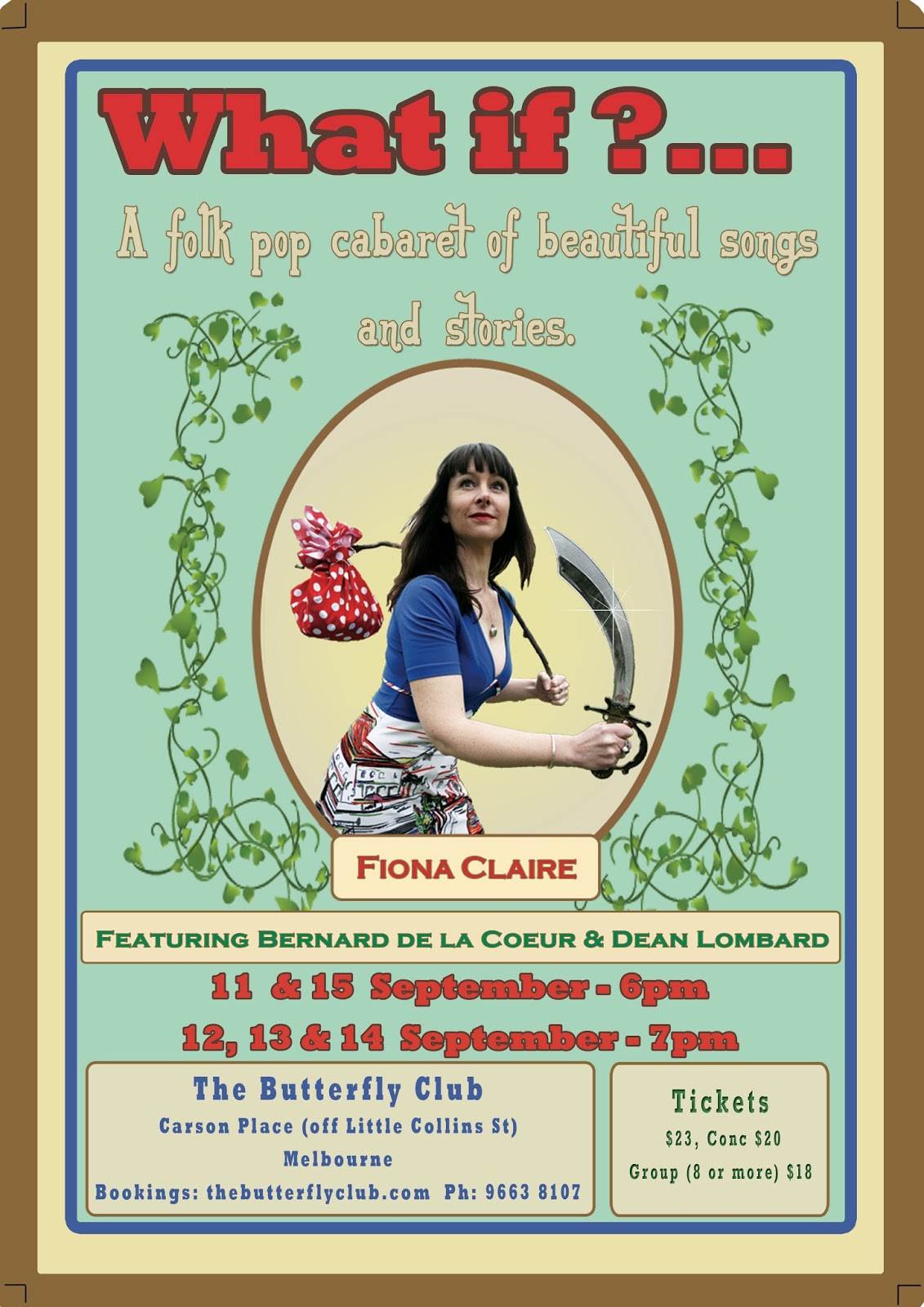
I am sitting at the piano rehearsing for my show “What If?...” and as I polish up my songs and stories I feel a familiar squeeze of nerves and expectation that precedes an opening night.  I know I have to submit to the process of building up the work until I have replaced doubt with confidence.  And there is no short cut to be taken.  Ironically my show explores the courage it takes to challenge our fears and desire to stay safe and comfortable.  I find myself, thinking about that old quote about life imitating art.  And I search the web - who said that anyway?


Wikipedia told me that it is a quote from Oscar Wilde, that life imitates art far more than art imitates life.  He said this to demonstrate opposition to the idea that great art simply aims to depict life accurately and in doing so celebrates nature and creation. This has been a prevailing view about art - that it shows us the world we live in and we enjoy it for its remarkable accuracy.  But art is more than that - as the ancient Greeks knew.  They spent years and invented many words in order to accurately discuss the relationship between art and life.  Socrates recognised that rather than simple imitation of fact, there is a always a gap between art and what it is depicting.  This gap is to do with individual perception and the fact that an artist can never attain an objective truth. Wikipedia ( http://en.wikipedia.org/wiki/Mimesis )says: Plato told of Socrates' metaphor of the three beds: one bed exists as an idea made by God ( thePlatonic ideal ) one is made by the carpenter in imitation of God's idea; one is made by the artist in imitation of the carpenter's.  Artistotle also recognised this gap and saw that it played an important part in the powerful experience art can have, that catharsis is enabled when we can relate to and empathise with a work but when it is removed from fact.  That it is art and not life, enables us to process it more consciously, when we are not caught up in the actual act.


Oscar Wilde, imitating himself?

Oscar Wilde and his contemporaries were also beginning to understand that the world we find ourselves living in is created by our perception.  In his essay, The Decay of Lying, Wilde explores the way in which the perception of our experiences is mediated by the artistic forms and ideas we have internalised - our beliefs influence our perception.  Nature is created by our brains, or at least our experience of nature is.  He went so far as to say that no one had ever noticed the fog in London until poets and artists created a set of beliefs about it being romantic and moody ( http://aestheticstoday.blogspot.com.au/2008/09/oscar-wilde-and-creation-of-london-fog.html ).

So the space between art and life is rich in so many ways - it can tell us about what the artist found important, what they chose to highlight, it enables us a place to contemplate reality from a distance and in turn it influences the way we perceive reality in the future.  We are changed by art.  And for the artist themselves?  They too are changed as they explore life and become part of the cycle of creating and living - processing their experiences, gaining understanding of them, expressing this to others, experiencing the acts of expressing, communication and of being received -  and so it goes on.

And what has all this theory about art got to do with me?  Well, I am diving head long in to the heart of it right now as I prepare for my upcoming show at The Butterfly Club in September.  As much as my show comes from an instinctive desire to tell stories and ideas with words and music, I am also choosing what to include, what to exaggerate, what to hide.  And as much as I know I need to be objective about making good work and entertaining my audience, as I bring this personal work to the stage, I can’t help but be processing the stories and be changed by the experience of performing them.  When the show is complete and the audience have left, I see it anew.  I know of many artists who say they do not know what their work is about until lots of time has passed  - and sometimes they never do!  The gap between reality and perception ensures that art’s meaning is always changing.  It is both confronting and exciting as I try to make my show a fulfilling expression of the themes of regret and hope, courage and fear, sadness and humour and balance this with the telling of stories from my real life.  Surely there is not too much to get bogged down in there!  It sure sounds serious, but believe me when I tell you it will be funny too!  Although it can be challenging, the satisfaction of bringing ideas to life and letting my dreams become action is immense, and it is made so much more when it is shared.

And what has this theory about art got to do with you?  I would like to invite you to take the risk of creating your own work.  Catharsis, emotional processing, fresh understanding of your experiences and the simple joy of action and making are all possible.  Whether it be a drawing, writing, poetry or music, whether it be of great skill or rudimentary self expression - making art is a wonderful way to get to know yourself and your world and to change it too!

What will you be making today?
Kind regards, 

Fiona Claire.

Work with me: Individual Counselling, Creativity and Therapeutic Singing and Songwriting Sessions by appointment. Email: fionaclaire@optusnet.com.au or call 0437 985 132



Monday, 22 July 2013


July Newsletter 2013
Love and Fear

Michael Leunig wrote a beautiful poem that I received as a gift from my beloved grandmother years ago in his book “A Common Prayer”.  It begins:  “There are only two feelings. Love and Fear.” and ends “ two frameworks, two results, love and fear. Love and fear.” ( To see the entire poem go to http://www.leunig.com.au/index.php/prayers?showall=&start=1 )

Over the years I often say the first line to myself when I am faced with decisions and dilemmas and find the meditation useful.   Many times I have been reading some weighty tome or listening to some wise lecturer and again the theme of love versus fear has been discussed.  I have thought about it a lot and noticed how often even the most complex set of circumstances can often become clear when looked at through these two lenses.  I ask the questions - What is loving in this story?  What is fearful? So simple and so profound.


And at this time of my life it is as important as ever as I make choices about work directions, parenting and upcoming performances.  As Leunig suggests, although we may often associate the words love and fear with emotions, how these two states motivate us, inform our actions and get passed on as outcomes to others, mean that they are much more than just personal feelings.  They have power.

Rather than analysing this notion intellectually, although I think the idea does stand up to logic, I am also interested in how we can feel these forces at work in our day to day to life.  Becoming aware of their power and influence in our actions and decisions can be very useful.  Choosing the loving action can take some courage, but knowing the intention is good gives us hope that the outcome will be too!  But how can we tell if an action is  motivated by love or fear?  Try feeling your way.

Love feels like:

Reaching out.
Growing.
Standing up to be counted.
Being compassionate and open.
Embracing.


Fear feels like:

Retracting.
Shrinking.
Hiding our true values.
Being defensive and angry.
Rejecting.


Once we are aware of which of these forces is present in us at a given moment, we have more choice about what we will do next.  Awareness gives us information and time to make an assessment. But what can we do when we are full of fear?

Recently, during a sleepless night, rather than lie in bed, my head full of chattering anxiety, I got up and began by writing out my list of worries - so at least I had them on paper in front of me.  Then I searched the internet for ways to conquer my fear - I needed some quick fixes!  Much of what I found was familiar to me, but it’s amazing what we forget when we are feeling anxious.  One website was quite business like ( forbes.com ) and spoke of having no excuses, feeling the fear and doing it anyway, stepping out of our comfort zone and taking decisive action.  All good points, but pretty cliched and easier said than done.  

I was comforted by the fact that there was so much writing about this subject, I was reminded that fear is normal!   As Nelson Mandela said: “The brave man is not he who does not feel afraid, but he who conquers that fear.” - Long Walk to Freedom.  So what can we do instead of act out of our fear or explode with anxiety?  After my search and a bit of sitting up in the dark I came up with my own list of fear busters - to be worked on and added to at any time.

  • BECOME AWARE.  First sit with the feeling and become aware of what it going on inside of you.  Is this fear taking hold?  Become aware of what you are afraid of.
  • REMEMBER IT”S NORMAL.  Let the fear come and go - remember that being afraid is normal and happens to everyone - yes everyone!
  • EXPRESS AND EXPLORE.  Find a way to express and explore your fears - drawing, writing, singing, moving - all these ways can help you to sit with your feeling and get more information about what’s really scaring you right now.
  • SEE WHAT IS IMPORTANT.  Fear can be an indicator that something is important to you and that you care.  
  • LOOK AT YOUR OPTIONS.  Become clear about what other choices you may have rather than defending or shrinking or acting out of your fear.  Perhaps you have a big challenge ahead of you and really want to do well - instead of being afraid, consider what can you DO to allay your fears.  Can you make preparations?
  • FEEL YOUR WAY.  Look at your other choices, and feel the difference when you consider those that are actions motivated by love - the things that feel like growing, learning, standing up and embracing.
  • DECIDE.  Decide to take actions that will support your challenge - gather resources, connect to other people, write a list of what you need to do in order to make the situation easier for yourself.  Deciding and committing to your decision feels much better than sitting in indecisive inaction.
  • BE RESPONSIBLE.  Only you can do this.
  • ACT.  This is the no excuses bit  - take action and watch your fears subside.  And the Nelson Mandela bit - everyone feels afraid, being brave means walking into the fear and choosing something different.
  • BE UNCOMFORTABLE.  I love the sentence “Walking into the fear” - so I am using it again.  This bit may feel uncomfortable but if you check in with yourself it might also feel like growing.
  • BE LIBERATED.  Lastly - it feels like being free!

There are a million different ways we can be prepared for difficult tasks but in the end we just have to step up and do what has to be done.  We all feel fear but we can become aware of its power and choose a different action - one that may be riskier but ultimately will be better.  An action that leans toward love and hope rather than asks us to hide our truth and shrink to fit a smaller version of ourselves.  

Love and Fear - I keep choosing love every day.


What does your fear busting list look like?

Kind regards, 

Fiona Claire.

Work with me: Individual Counselling, Creativity and Therapeutic Singing and Songwriting Sessions by appointment. Email: fionaclaire@optusnet.com.au or call 0437 985 132


Sunday, 23 June 2013

June Newsletter 2013 - Personal Mythology - Treasures and Burdens


June Newsletter 2013
personal mythology - treasures and burdens

I was indulging in one of my favourite treats, a cup of tea and the weekend paper.  In The Age’s Good Weekend on June 15, I came across an article called “Memory Games” by Claire Messud in which she talked about her memories of living for five years from the age of four in a big, old house in Sydney.  She described the house now as “ inevitably smaller....than in my memory” and said that it was “a crucial site in my personal mythology”.  The term personal mythology immediately resonated with me and stirred up my own memories and feelings associated with my time living in different houses as a child.  Messud’s article highlighted how strongly we can feel about our own stories and memories but also how this memory can grow more inaccurate with the years.  I am struck by how these stories inform our reactions, beliefs and behaviours and yet are ever changing and unstable.  Wikipedia says “Myth is a sacred narrative” and “grounded in the quintessential human ability to address the large questions of existence using symbolism, metaphor, and narrative.”  The Oxford Dictionary defines myth as: “a traditional story, especially one concerning the early history of a people or explaining a natural or social phenomenon, and typically involving supernatural beings or events.”  As we struggle to understand life, we make stories.
In her story Messud also lamented that as we get older we become aware of the “profound incommunicability of life’s experiences”. It was nice to be reminded that other’s also feel the chasm between what we express and what can be understood.  I believe that we all have a drive to be known, to be heard and to connect.  It is often stated as one of our strongest human needs.  For me, it manifested as a child in singing, everywhere, any time, to everyone.  As an artist, and we are all artists in some way, the drive never ends because communication is never complete, our work is only able to approximate what we wish to share.  One of the beautiful things about music, singing and songwriting is that they are art forms that can help us to communicate that which is beyond words.
In my songwriting classes I often speak about the sub-conscious soup we carry  in our minds, full of our stories and experiences, images, feelings and beliefs, stored away and fuelling our reactions and behaviours.  These individual mixtures and the symbols and ideas in our dreams are wonderful sources of creative work.  But sometimes these stories no longer serve us well and can begin to hold us back.  We may see ourselves or the world in ways that limit our ability to grow and adapt.  Recognising this is no easy task however because often we are emotionally attached to our personal mythologies and may even have built our lives around them.  Our stories can be rich in metaphor and drama and we can get so caught up in them that we mistake them for the truth.  Looking at them objectively can be painful. Taking a step back, telling our stories, analysing them, looking for evidence for their validity - these actions can help us to recognise when our stories are no longer useful and allow us to cherish them but also let them to change.  Michael White’s wonderful work on narrative therapy ( see his book Maps of Narrative Therapy, or see more at www.dulwichcentre.com.au/michael-white-archive) gives us great tools to unlock, explore and change our personal mythologies, enabling us to grow and forge positive paths.
As well as our personal mythologies, in this highly communicative age we must contend with the pressure of huge global narratives, coming to us continually via different levels of media.  In their article Mythic Perspectives for a World in Distress (published on www.innersource.net), Feinstein, Mortifee and Krippner state “Unless we can begin to discern what is life-affirming and what is life-denying in what the media feeds us, we are in danger of being psychically annihilated by one of our most auspicious tools.”  We need to search for what is meaningful for ourselves and strengthen our authentic values in order to avoid being overwhelmed by this continual bombardment.  
Once again creativity is an excellent way to become aware of our own stories and values, to change them if need be and to strengthen our authentic selves.  Eric Maisel’s inspiring works  ( The Van Gogh Blues , Mastering Creative Anxiety www.ericmaisel.com/books/) discuss the importance of making our own meaning as well as the courage required and the joy this journey can bring us.
In my work, exploring, harnessing, adapting and cherishing personal mythologies is an ongoing passion.  Ever curious about the human condition and our imaginations, I am honoured to guide clients through their own internal landscapes and excited when shadows are given light and values and ideas are unearthed.  For my own songwriting and story telling I go an adventures through the stories of my past, inevitably bringing them to the light of day and changing them in the process.  Our stories are never finished or static, but they are always interesting and worth sharing.
Below is a picture I took recently on a country drive.  Some scenery caught my attention and I headed off the main road to explore.  To me it's evocative of the search for home.
What stories are you making today?

Regards, 
Fiona Claire.

Work with me: Individual Counselling, Creativity and Therapeutic Singing and Songwriting Sessions by appointment. Email: fionaclaire@optusnet.com.au or call 0437 985 132


Monday, 20 May 2013


May Newsletter 2013
Self-esteem vs Self-acceptance and the lie of inner cleansing
I was in my late teens when I happened across my auntie’s health kick book, from memory it was called “Inner Cleansing”.  It was seductive.  The illustrated female nude on the front demurely looked away, her skin smooth and blemish free.  A conscientious child with a romantic soul, I was aware from a young age of a yearning for peaceful perfection.  I was plagued by the idea that my spots and bumps were due to faults of my own making.  Now I was excited, at last being clean and pure all the way through could be a possibility - I just had to follow the rules set out in this book. Easy.

But it wasn’t easy to stick to the rules, the message was overwhelming, and the attack of toxins never ending.  When I did manage to eat the prescribed way, I quickly fell off the wagon and felt I never achieved the state of being completely cleansed.  I was a failure.  I lived with this failing and hobbled on to adulthood, mostly successfully distracting myself from dwelling upon the impurities within me.

Still, the promise of cleansing and purity was alluring.  I wanted to make the right choices and achieve certainty so I could be safe in the knowledge that I’d made it.  Perfection promises that there will be no more troubles or mess ahead- but this is a lie.

The idea of inner cleansing, fasting, pursuing the health ideal of a fit and lean physique or achieving the fresh uncluttered palate of a tv commercial home - all these outwardly appealing endeavours have an underlying message - that in our current form we are not good enough and we need to change in order to be considered worthy.  To see ourselves as competent and high enough in the pecking order of life, is the basis of self-esteem.  But is self-esteem alone a worthwhile goal?  Any grade we make often seems to be earned from a comparison of winners and losers.

When Melbourne’s Myer store began offering botox injections at their city beauty counter the publicist went on the radio saying it was a great way for women to enhance their self-esteem.  Really?  This is what has become of a term once used as a measure of psychological health.  Self-esteem can now be bought in a syringe, but it’s effects won’t last!  

Our A-type high achieving obsessed culture and the commodification of everything has focussed in on our most personal domain - our bodies.  And here is where the most cash can be made because this is the one place we can never escape or pretend we don’t belong to - our own bodies - the emblem of our worth. 
The pursuit of a healthy self-esteem relies heavily on outside achievements.  High academic marks, prizes, standing out above the crowd, having noticeable traits of success such as the right body or the right house.  But we are surrounded by examples of those who have failed - and often they are held up to ridicule.  So there is the ever-present danger of not being able to maintain the high standards.
It turns out that self-acceptance is the anti-dote, because when we accept ourselves right now, as we really are, we can stop the constant pursuit of outside ideals as a way to bolster ourselves - because we know that we really are ok.  We take back the power we gave away when we looked to these outside scales as a measure of ourselves.

But it’s easier said than done.  I struggled with the notion that I had to love myself unconditionally.  Was this another pure ideal that I was supposed to achieve? I was embarrassed and confused when the words kept popping in to my mind - How can I truly accept myself when so much about me is wrong?

I took up the sensible challenge to accept myself as I was.  It was not a straight forward journey and was often painful,  embarrassing, and uncomfortable when I forced myself so sit with things not being perfect.  I took risks because I knew that hacking my way forward, however difficult, could be no worse than the exhausting chase of a better facade coupled with the inner cave of boredom and fear.

A veneer of self-esteem can often lead to the idea that “I will relax, be happy, be at peace, as long as I maintain my high standards” or, even worse, “I will delay these rewards until I reach the ideal weight, job ( insert your ideal here )”.  The irony is that self-acceptance blossoms when we allow ourselves to do the things we love.

These are my tips for self acceptance:

  • Forget Perfection!!  The fact that there is no such thing as perfect can never be shouted out loud enough as far as I am concerned!  Aiming for perfection will always lead to disappointment.  
  • Accept that crap is everywhere - in our bodies, our hearts, our minds and our world.  I’m sorry, but it’s true.
  • Have a laugh about the mess!  Laughing is good for you.
  • Appreciate both the positive and negative parts of yourself - they are both important and contribute to your unique insights.
  • Set goals that really are achievable.  Some goals can foster unhappiness, so reassess your goals if this is happening to you.  Some tweaking can make them more achievable.
  • Express yourself - it aids self knowledge and self awareness which are vital in order to develop compassion and respect for yourself.  Express your true emotions in a safe place and connect to your real values.  
  • Surround yourself with people who believe in you.
  • Find your inner-conviction and truth - you have an inner voice that needs to be heard and has wisdom to share.
  • Take risks!  Even when you are following your dreams you will not get the results you expect,  but you will learn something and you may have fun anyway!
  • Take action! Messy emotions like fear, shame and guilt keep us stuck and procrastinating - action can shift these blocks.
  • Explore! New things nourish you and inform you about what you do and don’t like.
  • Create! You knew I was going to say that didn’t you?
  • Creativity is how our heart can communicate with us - a path to self knowledge and healing.  
  • Design your own nourishing self-help environment, become aware of what makes you feel good and enables you to grow.  Don’t just take other people’s self-help ideas on board.
  • Offer yourself compassion.
  • Accept that you’ll never be pure - but you can be happy!
  • Write a song about it and sing it to yourself - you knew I was going to say that too didn’t you?

And there you have it.  The path to self-acceptance may not be smooth but it can be very interesting.

I have given up my hopes for inner cleansing - and I have never felt more healthy!

Wishing you lots of mess and laughs, 

Regards, 

Fiona Claire


Work with me: Individual Counselling, Creativity and Therapeutic Singing and Songwriting Sessions by appointment. Email: fionaclaire@optusnet.com.au or 
call 0437 985 132